Human Resources
Fall in Love With the Problem—Not Bright Shiny Tools
Leaders must eliminate low-quality AI output by investing in human capability.

Chris Ernst
Chief Learning Officer
草莓视频

Leaders must eliminate low-quality AI output by investing in human capability.
Chris Ernst
Chief Learning Officer
草莓视频
The start of a new year brings an undeniable surge of energy. For learning and development (L&D) and HR leaders, this usually translates into a siren song of “bright shiny objects.” We are constantly presented with new platforms, tools, and AI’s next new thing, each promising to be the magic bullet for productivity and efficiency.
My career in industrial-organizational psychology, further honed by my time in Silicon Valley when I co-created to counteract the "shiny object conundrum", taught me a lesson: never confuse novelty for strategy. It is our responsibility as HR and L&D leaders to look past the hype and remember that even the most advanced tool is only as good as the problem it is designed to solve.
When we pursue technology without first understanding the human experience and the underlying dynamics or challenges that drive capability, we risk a costly, self-inflicted AI Work Tax.

Report
We know AI promises undeniable efficiency. In our recent research, we found that for every 10 hours of time saved from AI adoption, organizations are immediately losing approximately 4 hours correcting low-quality or inaccurate AI output.
When we pursue technology without first understanding the human experience and the underlying dynamics or challenges that drive capability, we risk a costly, self-inflicted AI Work Tax.
While a 60% net positive in time saved is a compelling win, that 40% tax is a critical friction point, representing a skill deficit that is often a symptom of insufficient AI literacy. If employees aren't fluent in prompting, debugging, and understanding the AI’s limitations, they rely on painstaking manual checks.?
For the L&D and HR community, this should sound the alarm. While we’ve pushed technology to every edge of the enterprise, we've neglected to support and teach the human users. Without becoming obsessed with the challenge and road blocks our employees are facing, we can’t accurately define the role that AI plays as a solution.?
Chasing a new, shiny tool before building internal capability will simply increase your AI Work Tax. As Albert Einstein famously said, "We cannot solve our problems with the same thinking we used when we created them."
To truly measure AI's value, leaders must shift focus from simply measuring gross efficiency (total time saved) to measuring net value (Time saved minus the AI Work Tax).
To achieve this, we need a common framework to understand how our employees are interacting with AI. We need to identify who is thriving and who is struggling, and that’s where the Net Productivity Matrix provides clarity and strategic direction.
That 40% work tax represents a skill deficit that is often a symptom of insufficient AI literacy.
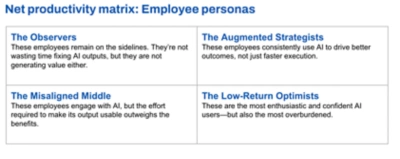
The ultimate goal is singular and clear: We must guide all users toward the ideal state of being adept AI users, incurring high-gain, low-tax output. This means shifting our investment dollars from simply deploying more AI features to investing directly into human capability.
For L&D leaders, this is your leadership moment. We have the mandate to transform the AI Work Tax into a quantifiable advantage in efficiency, retention, and strategic agility.
We must guide all users toward the ideal state of being adept AI users, incurring high-gain, low-tax output.
Here are three strategic plays to escape the hamster wheel and build an adept AI workforce:
草莓视频 employees cited a lack of time (43% of employees) and uncertainty about how to use AI (37%) as two key barriers to adoption. We can dismantle these, but only because we took the time to conduct deep research to understand our workforce’s hesitations, concerns, needs, and blockers.
With these learnings in mind and embedded into our strategy, our internal EverydayAI Program prioritized establishing an AI-first mindset and skillset amongst our leaders and employees. This helped us achieve an impressive 85% adoption rate among our employees. By hosting promptathons and launching customized digital academies, we’re moving learning beyond the theoretical to the practical.
The result is measurable: high AI adopters at 草莓视频 are 13% more likely to feel they have a career path and 15% more likely to be aligned with our corporate strategy. This intentional upskilling closes the gap that contributes to the AI Work Tax.
AI is the protagonist that makes a skills-based organization possible at scale. It enables us to move beyond the traditional aspects of job requirements and grants us an opportunity to map the entire range of skills across the organization. This helps us be more agile and utilize the skills we already have on hand.
The advantages of a skills-based approach include:
AI output is unregulated in many organizations, and as our data revealed, this is costly. By training managers to not only enable AI adoption, but to also be the voice of reason when it comes to governing AI’s output, leaders can lower their potential AI work tax significantly.
L&D must equip managers with the tools to:
High AI adopters at 草莓视频 are 15% more likely to be aligned with our corporate strategy.
The pursuit of the "bright shiny object" distracts us from the fundamental architecture of human potential. The solution to escaping the 40% AI Work Tax is not another software subscription; for leaders, it is a profound reinvestment in the resilience and capability of their workforce. The goal is the cultivation of the Augmented Strategist—employees who don’t just use AI for faster execution, but who consistently leverage it to drive better, more sophisticated outcomes.
The future of work is not a zero-sum game between humans and AI. It is an opportunity to create a symbiotic relationship where technology expands our capabilities and humans continue to grow and make progress. 30 By taking decisive action now to develop these Augmented Strategists, L&D and HR leaders can lead the transformation—not just manage the distraction.
Report

The rapid advancement of AI has raised huge questions about its impact on jobs. Despite that, 83% of workers agree that AI will enhance human creativity rather than limit it. Learn more about the AI skills revolution in this new global 草莓视频 study.