Top 5 AI Agent Frameworks for 2026
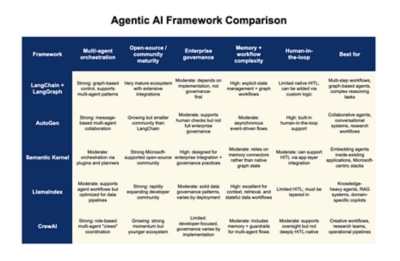
Organizations evaluating AI agent frameworks are looking for platforms that can support reliable agents and complex multi-step tasks without sacrificing on governance or flexibility. Leading frameworks take different approaches—some focus on graph-based control flow, others on data-centric retrieval, and some on multi-agent coordination or orchestration.
Understanding each framework’s design and the real-world they power helps teams match their agent use cases to the right foundation and architecture. Here are five of the top AI agent frameworks available to businesses in 2026.
?
LangChain is an open-source framework for building AI applications with large language models, and LangGraph extends it with a graph-based runtime for long-running, stateful workflows and agents.
Key capabilities:
- Graph-based workflows: Models agent behavior as a graph, with nodes representing steps and edges representing transitions, including support for single-, multi-, and hierarchical-agent patterns
- Stateful execution: Provides shared state and persistence for long-running workflows and iterative agent loops
- Ecosystem integrations: Connects to a wide range of models, vector stores, tools, and data sources through the broader LangChain ecosystem
Best suited for: Teams that want fine-grained control over agent workflows, especially multi-step or multi-agent applications that benefit from explicit graph structure and state management.
?
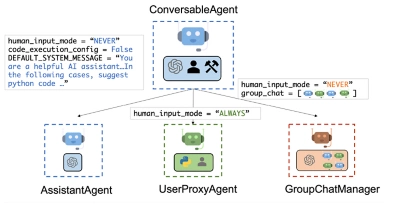
AutoGen is an open-source programming framework from Microsoft for building agents and multi-agent applications, with a strong focus on conversational and collaborative interactions.
Key capabilities:
- Multi-agent collaboration: Enables multiple specialized agents to communicate via messages and cooperate on tasks
- Human-in-the-loop support: Allows agents to work autonomously or alongside human users, with configurable intervention points
- Asynchronous workflows: Supports event-driven, asynchronous interactions between agents to handle more complex workflows
Best suited for: Applications that center on conversational agents, collaborative problem-solving, or scenarios where humans and agents need to work together within the same workflow.
?
Semantic Kernel is Microsoft’s lightweight, open-source SDK for building AI agents and integrating large language models into .NET, Python, and Java applications.
Key capabilities:
- Plugin and skill model: Organizes capabilities into plugins and functions that agents can invoke, allowing structured tool use and orchestration
- Model-agnostic orchestration: Supports multiple model providers while offering a common abstraction layer for prompts, plans, and executions
- Enterprise alignment: Designed to act as middleware in production systems, integrating with existing application code and services
Best suited for: Engineering teams that want to embed agent capabilities directly into existing applications, especially in Microsoft-centric environments, while keeping a clear separation between orchestration logic and business code.
?
LlamaIndex is an open-source framework that began as a data layer for LLM applications and has evolved into a developer-focused framework for context-aware AI agents and workflows.
Key capabilities:
- Data-centric design: Provides tools for ingesting, indexing, and querying private or enterprise data so agents can ground their reasoning in relevant context
- RAG and agents: Offers retrieval-augmented generation pipelines and agent abstractions that can chain retrieval, reasoning, and action-taking
- Event-driven workflows: Supports stateful, event-driven workflows and custom agents that operate over structured and unstructured data
Best suited for: Knowledge-intensive applications—such as research assistants, internal copilots, and domain-specific agents—that must reliably interact with complex or proprietary data sources.
CrewAI is an open-source Python framework for building and orchestrating multi-agent "crews,” or groups of specialized agents that collaborate to complete tasks.
Key capabilities:
- Role-based agents and crews: Lets developers define agents with specific roles and skills, then organize them into coordinated crews for end-to-end workflows
- Built-in guardrails and memory: Includes mechanisms for memory management, knowledge, and guardrails to help keep multi-agent interactions on track
- Developer and UI tooling: Offers both a code-first experience and visual tools for designing, testing, and deploying multi-agent workflows
Best suited for: Teams that want to structure work as collaborative, role-based multi-agent processes—such as content pipelines, research workflows, or operational automations—without building their own orchestration layer from scratch.